A Precision Medicine Approach to Foot and Ankle Healing
When Standard Treatments Fall Short
If you are living with foot or ankle arthritis, a stubborn tendon injury (such as Achilles or peroneal tendinopathy), plantar fasciitis, or a cartilage lesion of the ankle, you already know how limiting it can be. These conditions make walking, working, and staying active painful, and standard options often fall short.
Anti-inflammatories, bracing, physical therapy, and cortisone injections can help, but cortisone relief can carry complications and is often temporary, and surgery is a major commitment. Many patients are seeking an effective biologic option that works with the body’s natural healing capabilities.
The Gap Between Cortisone and Surgery
Time is cartilage, and time is tissue: Waiting or relying on temporary fixes is not a neutral choice. Untreated or under-treated foot and ankle conditions rarely stay static—chronic tendon pain can progress to partial tearing, and early arthritis can stiffen and deteriorate.
Repeated cortisone injections carry cumulative risks to cartilage and soft tissue over time. Meanwhile, forced inactivity to avoid pain negatively impacts weight, mental and cardiovascular health, and overall quality of life.
Healing Through Precision Medicine
We advocate for your recovery by utilizing orthobiologics—treatments using your body’s own cells and growth factors to relieve pain, improve function, and support tissue healing with a strong safety record and minimal downtime. Used thoughtfully and in the right patient, they may relieve pain, improve function, and in some cases support healing, often with a strong safety record and minimal downtime.
To ensure success, we rely on a precision medicine approach. We use advanced imaging and extended treatment evaluations to pinpoint your exact anatomical needs and match them to the most scientifically supported option. It is technical, but important to strictly differentiate between:
• “361” Products: Autologous or minimally processed tissues requiring FDA registration.
• “351” Products: Heavily processed tissues regulated as biologic drugs requiring formal FDA approval.
Treatment Options (Evidence-Grounded Breakdown)
1. Platelet-Rich Plasma (PRP)
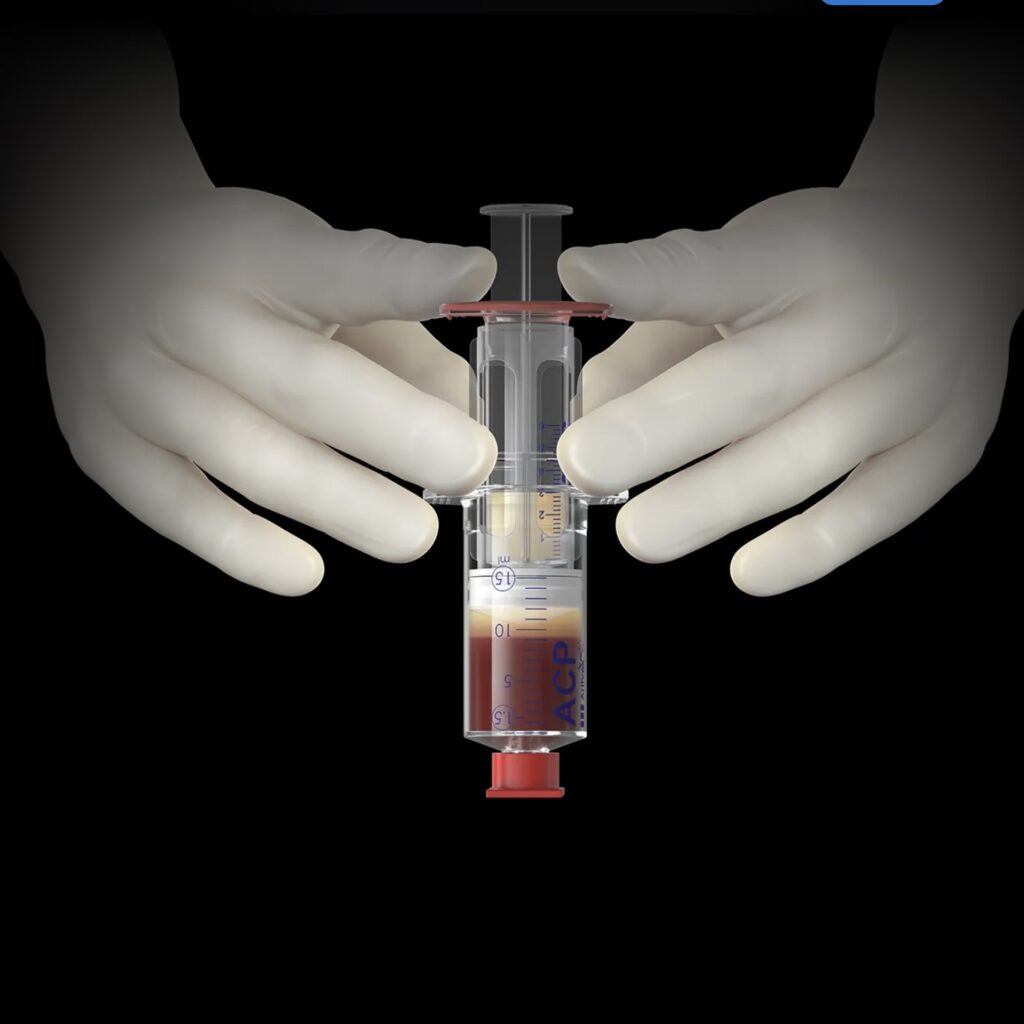
- What It Is: A small sample of your own blood is centrifuged to concentrate platelets and growth factors, which are injected into the injured tissue.
- Multiple RCTs and meta-analyses show PRP provides pain relief for plantar fasciitis comparable to—and at 6–12 months superior to—cortisone injections: Hohmann et al., AJSM, 2021 (Meta-Analysis, A, 1a); Peerbooms et al., AJSM, 2019 (RCT, A, 1b).
- Extended follow-up demonstrates superior pain relief over cortisone at 6–18 months: Cooper, JAMA, 2023 (Narrative Review, D, 5).
- National sports medicine guidelines recognize positive randomized trial results across tendon and fascia conditions: American Medical Society for Sports Medicine Position Statement, 2021 (Expert Consensus, D, 5).
- Multiple RCTs and meta-analyses show PRP provides pain relief for plantar fasciitis comparable to—and at 6–12 months superior to—cortisone injections: Hohmann et al., AJSM, 2021 (Meta-Analysis, A, 1a); Peerbooms et al., AJSM, 2019 (RCT, A, 1b).
- Precision Note: PRP is not a universal cure; we use precision imaging to ensure correct patient selection. Several well-designed trials show no significant difference between PRP and saline for Achilles tendinopathy.
2. Bone Marrow Aspirate Concentrate (BMAC)
- What It Is: Bone marrow is harvested (usually from the heel or leg bone) and concentrated to capture progenitor cells and growth factors that support cartilage, bone, and tendon healing.
- Improved function and reduced pain reported for osteochondral lesions of the talus (OLT) and acute Achilles ruptures without serious adverse events: Bachir et al., Arthroscopy, 2023 (Systematic Review, C, 4).
- High-quality randomized trials are currently lacking: Glenn et al., FAI, 2021 (Narrative Review, D, 5).
- Improved function and reduced pain reported for osteochondral lesions of the talus (OLT) and acute Achilles ruptures without serious adverse events: Bachir et al., Arthroscopy, 2023 (Systematic Review, C, 4).
- Precision Note: Our precision protocol utilizes BMAC as a powerful surgical add-on to support healing of cartilage repairs and difficult fusions, rather than as a standalone office injection, because high-quality randomized trials are currently lacking (Glenn et al., Foot & Ankle International, 2021, Topical/Narrative Review, D, 5)
3. Microfragmented Adipose Tissue (Lipogems)
- What It Is: Autologous fat harvested (like a mini-liposuction), washed, and mechanically fragmented without enzymes to preserve supportive structural cells.
- In a prospective study of early-to-moderate ankle arthritis, a single injection produced statistically significant pain and functional improvements sustained at 12 months in ankle arthritis: Natali et al., Int Orthop, 2021 (Prospective Non-Randomized Study, B, 2b).
- Across joints, the Lipogems system (manufactured by Lipogems International) has shown consistent improvements in pain and function in early-to-moderate osteoarthritis: Parmar et al., Regen Med, 2026 (Narrative Review, D, 5).
- In a prospective study of early-to-moderate ankle arthritis, a single injection produced statistically significant pain and functional improvements sustained at 12 months in ankle arthritis: Natali et al., Int Orthop, 2021 (Prospective Non-Randomized Study, B, 2b).
4. Other Tissue Products (Ready To Use “351 – Processed”)
As of the writing of this article, there are roughly a dozen amniotic-derived products marketed for musculoskeletal use that differ substantially in tissue source, processing, and form—differences that affect their biology and regulation. Huddleston et al., Curr Rev Musculoskelet Med, 2020 (Narrative Review, D, 5); Sultan et al., Clin J Sport Med, 2020 (Narrative Review, D, 5).
It is important to note that when injected for arthritis or tendinopathy, the FDA generally considers it an off-label/non-cleared “351” biologic-drug use (Zaslav, Arthroscopy, 2022 (Expert Commentary, D, 5))
Essentially this means that while Doctors can safely still use this therapy, the product cannot be advertised as such.
- ClarixFlo™ (manufactured by Amniox Medical / TissueTech): ClarixFlo is a processed umbilical amniotic membrane product regulated by the FDA as a “361” tissue cleared to cover and protect wounds.:
- Early small studies suggest pain and functional improvements in plantar fasciitis: Hanselman et al., 2015 (Pilot RCT, B, 2b); Cazzell et al., 2018 (RCT, A, 1b); Zelen et al., 2013 (Feasibility RCT, B, 2b).
- Meta-analyses urge caution regarding low baseline quality and preliminary data: Oesman et al., J Foot Ankle Surg, 2026 (Meta-Analysis, A, 1a).
- Early small studies suggest pain and functional improvements in plantar fasciitis: Hanselman et al., 2015 (Pilot RCT, B, 2b); Cazzell et al., 2018 (RCT, A, 1b); Zelen et al., 2013 (Feasibility RCT, B, 2b).
- Micronized Dehydrated Human Amnion/Chorion Membrane (mdHACM – AmnioFix™ / EpiFix™):
- For plantar fasciitis, a Level I randomized trial showed mdHACM products, like those in the significantly outperformed saline for pain and function at 3 months: Cazzell et al., FAI, 2018 (RCT, A, 1b); Zelen et al., FAI, 2013 (Feasibility RCT, B, 2b).
- Case series also report improvement in chronic Achilles tendinopathy, mixed tendinopathy/arthritis, and meaningful knee improvement at 6 months: Spector et al., JAPMA, 2021 (Case Series, C, 4); Gellhorn & Han, PM&R, 2017 (Case Series, C, 4); Alden et al., J Knee Surg, 2021 (Case Series, C, 4).
- For plantar fasciitis, a Level I randomized trial showed mdHACM products, like those in the significantly outperformed saline for pain and function at 3 months: Cazzell et al., FAI, 2018 (RCT, A, 1b); Zelen et al., FAI, 2013 (Feasibility RCT, B, 2b).
- Amniotic Suspension Allograft (ASA – ReNu / PTP-001):
- This category has the single best “off-the-shelf” evidence, including a Level I trial where ASA products, / PTP-001, outperformed hyaluronic acid and saline for knee OA at 6 months. Farr et al., STEP Guidelines, 2022 (RCT, A, 1b).
- Additional lower-level knee studies suggest pain relief and possible delay of knee replacement: Vines, Castellanos, Mead, STEP Guidelines, 2022 (Retrospective Study, C, 4).
- This category has the single best “off-the-shelf” evidence, including a Level I trial where ASA products, / PTP-001, outperformed hyaluronic acid and saline for knee OA at 6 months. Farr et al., STEP Guidelines, 2022 (RCT, A, 1b).
- Dehydrated Amnion/Chorion Membrane Sheets (AmnioFix®, EpiFix®, BIOVANCE®, AmnioBand®):
- Controlled trials demonstrate improved range of motion and reduced scarring as a surgical barrier wrap around repaired flexor tendons: Roy et al., BioMed Res Int, 2021 (Controlled Non-Randomized Trial, B, 2b).
- AmnioFix® (Sheet / Allograft): Manufactured by MiMedx, this is the most common dHACM sheet used in orthopedic and sports medicine surgeries. It is frequently applied as an onlay allograft or barrier wrap around repaired tendons (like the Achilles or flexor tendons) and nerves to protect the tissue and reduce scar formation.
- EpiFix®: Also manufactured by MiMedx, this dHACM sheet utilizes the same tissue processing technology as AmnioFix but is primarily marketed and packaged for external wound care, such as diabetic foot ulcers and burn coverage.
- BIOVANCE®: Manufactured by Celularity (and often distributed by Arthrex in the orthopedic space), this is a decellularized, dehydrated human amniotic membrane sheet used as a surgical barrier to preserve tissue planes and minimize fibrotic scarring around tendons and surgical sites.
- AmnioBand®: Manufactured by MTF Biologics, this is a dehydrated placental membrane allograft used primarily as a wound and surgical covering.
- AmnioFix® (Sheet / Allograft): Manufactured by MiMedx, this is the most common dHACM sheet used in orthopedic and sports medicine surgeries. It is frequently applied as an onlay allograft or barrier wrap around repaired tendons (like the Achilles or flexor tendons) and nerves to protect the tissue and reduce scar formation.
- Controlled trials demonstrate improved range of motion and reduced scarring as a surgical barrier wrap around repaired flexor tendons: Roy et al., BioMed Res Int, 2021 (Controlled Non-Randomized Trial, B, 2b).
Overall Evidence Synthesis:
A 2025 meta-analysis of amnion allograft injections found significant pain reduction and functional improvement versus controls, though only 3 of 7 studies had low risk of bias: Hou et al., AJPMR, 2025 (Meta-Analysis, A, 1a); Zaslav, 2022 (Expert Commentary, D, 5); Gupta, Pharmaceuticals, 2022 (Narrative Review, D, 5); Duerr et al., Clin Sports Med, 2019 (Narrative Review, D, 5).
Your Personalized, Precision Medicine Plan
The key word is personalized. There is no single “best” biologic—the right choice depends on your specific diagnosis, the severity and stage of your condition, your goals, your imaging, and your overall health. That is a decision made together, case by case.
If you want to know whether an orthobiologic option is right for you, schedule a consultation. Together we will review your diagnosis and imaging, discuss realistic expectations, and build a precision plan tailored specifically to you—including an honest conversation about evidence, regulatory status, alternatives, and cost.
A Return to the Activities You Love
Used in the right patient, for the right problem, at the right time, these biologics offer a genuinely appealing path: harnessing your own healing biology, avoiding or delaying surgery, and doing so with an excellent safety track record and quick recovery. Many patients experience meaningful, lasting pain relief and a return to the activities they love.
Take the Next Step
Call the office or request an appointment today to discuss whether PRP, BMAC, microfragmented adipose, or another approach fits your situation. Bring your questions. The goal is a shared, informed decision with optimism grounded in honesty.
Disclaimer: This handout is for education only and is not a substitute for an individual medical evaluation. It does not guarantee any particular outcome. Some treatments described may be used off-label; All of these treatments are generally not covered by health insurance.